
Table of Contents
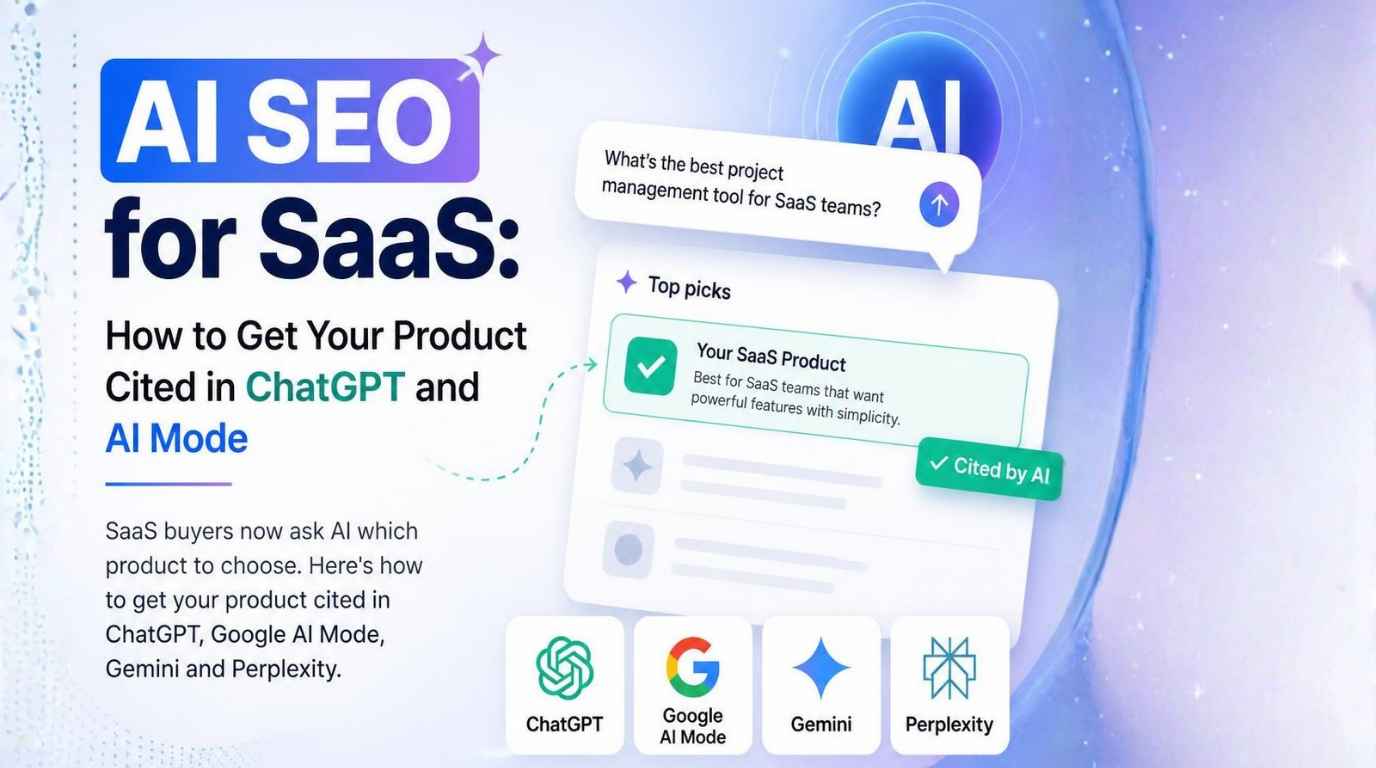
If you sell software, your buyers are now doing something fundamentally different. They are not searching Google for “best [category] tool” and comparing five blog posts. They are opening ChatGPT and asking: “What’s the best project management tool for a 20-person remote team?”
The AI names three products. Yours either is one of them, or it isn’t.
This shift is not coming — it is already here. A growing share of B2B discovery starts with an AI assistant rather than a search engine. For SaaS companies, this changes the top-of-funnel completely. Instead of competing for organic rankings against every review site and competitor blog, you are competing to be one of the 3–5 named sources that the AI engine trusts.
This post covers the exact AI SEO playbook for B2B SaaS — how to get your product cited in ChatGPT, Google AI Mode, Gemini, and Perplexity, and how to turn those citations into inbound demo requests.
Why SaaS Discovery Happens on AI Now
The shift from search engines to AI assistants for B2B discovery is driven by a simple reason: AI assistants give better answers for purchase decisions.
When a buyer searches “best CRM for startups” on Google, they get 10 blue links — a mix of review sites, comparison pages, competitor pages, and search-engine-optimized listicles. The buyer has to read multiple pages, compare claims, and make their own judgment.
When the same buyer asks ChatGPT the same question, they get a single coherent answer: “Based on your needs, here are the three best CRMs for startups, why each fits, and who they work best for.” The answer cites sources, compares features, and matches products to use cases.
This is faster, more useful, and more trusted by buyers. As a result, the habit is spreading rapidly:
- SaaS buyers use AI to shortlist products before they visit any website
- AI assistants are used for comparison queries (“Tool X vs Tool Y”)
- Pricing, feature, and integration questions are answered by AI before any sales conversation
- ChatGPT Shopping and Google AI Mode both cite product-level data from websites, not ads
If your product is not cited in these answers, you are losing pipeline at the very top of the funnel — before the buyer even knows your name.
The SaaS AI SEO Checklist
Here is the exact checklist we use when optimizing a SaaS product for AI citation. Each item is discrete and measurable.
1. Product Schema (SoftwareApplication)
This is the single highest-impact action you can take. Most SaaS websites have no schema markup on their product pages. AI engines cannot confidently cite a product they cannot structurally identify.
The schema type you need is SoftwareApplication. On your product or pricing page, implement the following properties:
name— The exact product nameoperatingSystem— Web, Mac, Windows, iOS, Android, or allapplicationCategory— The category of software (e.g., “ProjectManagement,” “CRM,” “Analytics”)offers— Pricing information withprice,priceCurrency, anddescriptionof the planaggregateRating— If you have third-party reviews, include the rating value and review countdescription— A concise, factual description of what the product doesurl— The product page URLimage— The product logo or screenshot
Use Google’s Rich Results Test to validate the implementation. If it passes, your product is now machine-readable by Google’s index — and therefore by Gemini and AI Mode.
2. Comparison Page Optimization
AI engines cite comparison pages more than any other content type for SaaS. When ChatGPT answers “what’s the best tool for X” or “Tool A vs Tool B,” it pulls information from comparison content.
Structure each comparison page as follows:
- Overview section — What each product does, who it’s for, what it costs
- Feature comparison table — Side-by-side columns with checkmarks, numbers, or “Yes/No”
- Pricing comparison — Price per seat or per month, with what’s included at each tier
- Use case matching — “Choose Tool A if you need X. Choose Tool B if you need Y.”
- Verdict section — A clear, declarative recommendation statement
The verdict section is particularly important for AI citation. A clear statement like “Tool A is the best choice for teams of 10–50 who need advanced reporting” is exactly the format that AI engines extract and cite.
Comparison pages to create (in priority order):
- “Your Product vs Competitor A” (your direct competitor)
- “Your Product vs Competitor B”
- “Best [Category] for [Use Case 1]”
- “Best [Category] for [Use Case 2]”
- “[Category] Pricing Comparison 2026”
3. Category Landing Pages
Category landing pages are the pages that answer broad queries like “What is the best project management software?” or “Best CRM for small business.” These pages are different from your homepage — they are designed to rank for category-level queries and be cited by AI engines.
Each category page should include:
- A brief overview of the category and what buyers should look for
- A ranked or categorized list of products with brief explanations
- A detailed section about your product: who it’s for, key features, pricing
- A comparison of how your product fits different use cases
- FAQ section at the bottom with schema markup
These pages are your primary AI Mode citation targets. When Gemini generates an answer for a broad category query, it pulls from these pages.
4. Original Data and Benchmarks
AI engines cite original data at more than 10 times the rate of standard content. For SaaS, the most citable data types are:
- Pricing benchmarks — “2026 SaaS Pricing Report: What 500 Companies Charge for [Category]”
- Usage statistics — “How Teams Use [Category]: Data from 1,000 Companies”
- Industry surveys — “State of [Industry] in 2026: Key Trends and Statistics”
- ROI case studies — Aggregated, anonymized data on time saved or revenue generated
Each piece of original data becomes a citation asset. Once published, it lives on your website and generates citations across AI platforms indefinitely. The upfront investment pays back through continuous citation compounding.
A single benchmark report can be cited by ChatGPT, Google AI Mode, Perplexity, and Gemini within weeks of publication — and remain a cited source for months or years.
5. Entity SEO
AI engines need to confidently identify your brand as a distinct, verified entity before they cite you in answers. Entity SEO for SaaS means:
Crunchbase profile. Crunchbase is one of the most authoritative entity sources for B2B companies. AI engines reference it heavily. Ensure your profile has:
- Company name, description, and logo
- Founders and leadership team listed
- Funding rounds and amounts (if applicable)
- Headquarters location
- Website and social links
Wikidata entry. If your product is well-known enough, a Wikidata entry helps AI engines resolve your brand name to a structured entity. This is particularly useful for disambiguation — if there are multiple companies with similar names, Wikidata tells the AI which one is yours.
G2, Capterra, and GetApp profiles. Even if you don’t actively manage these, your product likely has profiles on these platforms. Claim them, update the information, and ensure review counts are visible. AI engines parse review data as a trust signal.
LinkedIn company page. This is another entity signal. Keep your LinkedIn page updated with complete information, logo, description, and employee count.
Consistent naming everywhere. Your brand name, product name, and tagline must be identical across every platform. Inconsistencies confuse entity resolution and reduce citation probability.
6. AI-Citable Content Production
The content format that gets cited by AI engines is different from the content format that ranks in traditional search.
AI-citable content follows these rules:
- Short, declarative sentences — “Product X integrates with 200+ tools.” Not “Seamlessly connect your workflow with a vast ecosystem of business applications.”
- Named sources for every claim — When you state a statistic, link to the source. AI engines verify claims before citing.
- Expert quotes with credentials — “According to [Name], CEO of [Company],…” — named experts are cited more than anonymous statements.
- FAQ sections on every page — Structured Q&A in FAQ schema format. Each pair is a potential AI citation.
- Use-case-specific sections — “Who is this for?” sections with clear audience definitions. AI engines match products to user needs using these sections.
What We Did for a SaaS Client (Anonymized Case Study)
A B2B SaaS company in the analytics space came to us with strong domain authority, good organic rankings, and zero AI citations. Their buyers were asking ChatGPT for recommendations in their category and finding two competitors named — but not this product.
Week 1–2: Audit We ran an AI Visibility Audit across all six platforms. Zero citations for any of their tracked queries. Competitors were cited on ChatGPT and Perplexity for 8 category queries. The gap was clear.
Week 3–4: Foundation
- SoftwareApplication schema shipped on all product and pricing pages
- Organization schema completed with sameAs links to Crunchbase, LinkedIn, and G2
- Crunchbase profile updated with leadership, funding, and description
Week 5–6: Content
- 3 comparison pages published (“Product vs Competitor A,” “Product vs Competitor B,” “Best [Category] for Enterprise vs Startup”)
- Pricing benchmark report published (original data from 200 companies)
- FAQ schema added to all comparison pages and the pricing page
Week 7–10: Monitoring
- First citation appeared at week 6: ChatGPT cited their pricing benchmark report
- Perplexity citations started at week 7: 2 queries
- AI Mode citations appeared at week 8: 1 category query
Week 12: Results
- Cited on ChatGPT for 6 category queries
- Cited on Google AI Mode for 22 commercial keywords
- Inbound demo requests attributed to ChatGPT: 6+ per week
- Inbound MQLs attributed to AI Mode: 14+ per week
The total paid ad spend for this pipeline: zero. The entire top-of-funnel was driven by AI citations from content and schema work that continues to compound.
Quick Wins for SaaS Founders This Week
If you want to start getting your product cited by AI engines, here are five things you can do this week — each one takes less than an hour.
- Check your product schema. Search Google for “Rich Results Test.” Enter your product or pricing page URL. If SoftwareApplication schema is missing or has errors, fix it.
- Publish one comparison page. Write “Your Product vs Competitor A” with a feature table, pricing comparison, and use case verdict section. This is the most-citable content format for SaaS.
- Audit your Crunchbase. Search for your company on Crunchbase. Is the profile complete? Does it have a logo, description, funding, and leadership? Update anything missing.
- Add Click-to-WhatsApp on your pricing page. Once AI citations drive awareness, you need to capture intent. A WhatsApp click-to-chat button on the pricing page lets prospects book a demo in 60 seconds.
- Run an AI Visibility Audit. The most important step. You need to know where you stand before you decide what to optimize. We do this free.
The Bottom Line
SaaS discovery has shifted. Your buyers ask AI which product to choose. If your product is cited in those answers, you generate inbound pipeline with zero ad spend. If it’s not cited, you are invisible to a growing share of your market.
The playbook is clear: product schema, comparison pages, original data, entity SEO, and AI-citable content. Each step is measurable. Each one compounds over time. The brands that start now will build a citation advantage that late entrants cannot easily replicate.
Is your SaaS product cited in ChatGPT and AI Mode?
We’ll run a free AI Visibility Audit across Google AI Mode, ChatGPT, Gemini, Perplexity, Claude, and Copilot. Delivered in 5 business days. No pitch, no pressure.